Effective trading strategies often rely on a clear separation between trend identification and trade execution. Momentum-based indicators are commonly used to detect the beginning of directional movement, while volatility channels help identify structured entry opportunities within that movement.
The combination of Momentum Pro and Superior Keltner follows this principle. Momentum Pro defines when a new directional phase begins, while Superior Keltner provides the trade signals that align with that direction.
Strategy Structure
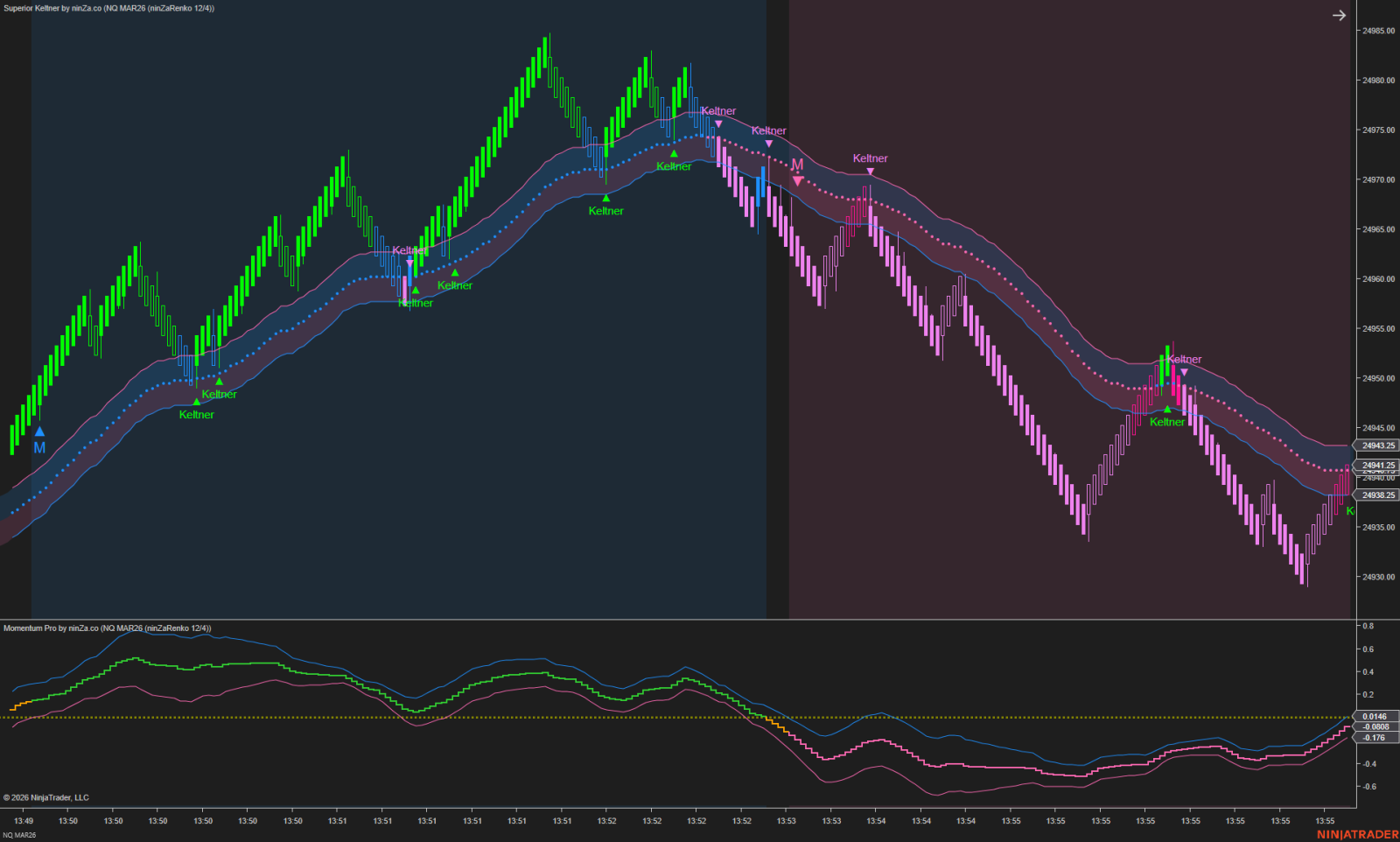
1. Trend Identification with Momentum Pro
Momentum Pro serves as the primary directional filter.
When Momentum Pro crosses above the zero level, it signals that upward momentum is emerging and the market is entering an uptrend phase.
When Momentum Pro crosses below the zero level, it indicates increasing bearish momentum and the market transitions into a downtrend phase.
The zero level acts as the key reference point that defines the prevailing direction.
Only trades that follow the direction indicated by Momentum Pro are considered valid.
2. Trade Execution with Superior Keltner
Superior Keltner is used to identify trade opportunities within the active trend. The indicator provides signals based on price interaction with the Keltner channel structure.
These signals are only executed when they align with the directional bias defined by Momentum Pro.
Trading Rules
Long Setup
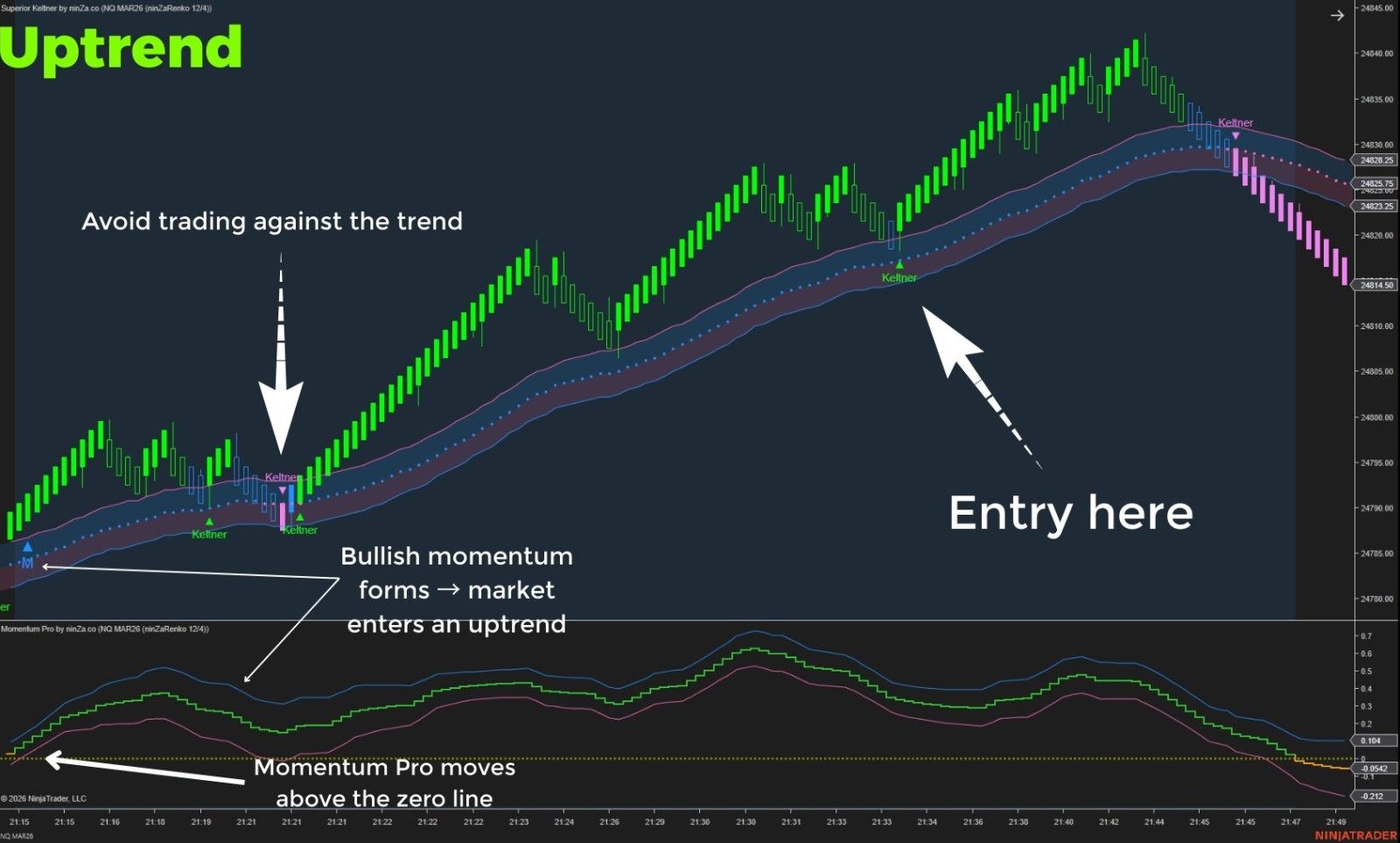
Required conditions:
Momentum Pro crosses above the zero level, indicating that an upward momentum phase has begun.
Superior Keltner generates a buy signal within the rising market structure.
A long position is executed when these two conditions align.
Any sell signal generated by Superior Keltner while Momentum Pro remains above zero is ignored. Counter-trend trades are not taken during an active bullish momentum phase.
Stop loss is typically placed below the most recent swing low or below the lower Keltner channel boundary.
Profit targets may be defined using the next resistance level or a minimum Risk–Reward ratio of 1:2.
Short Setup
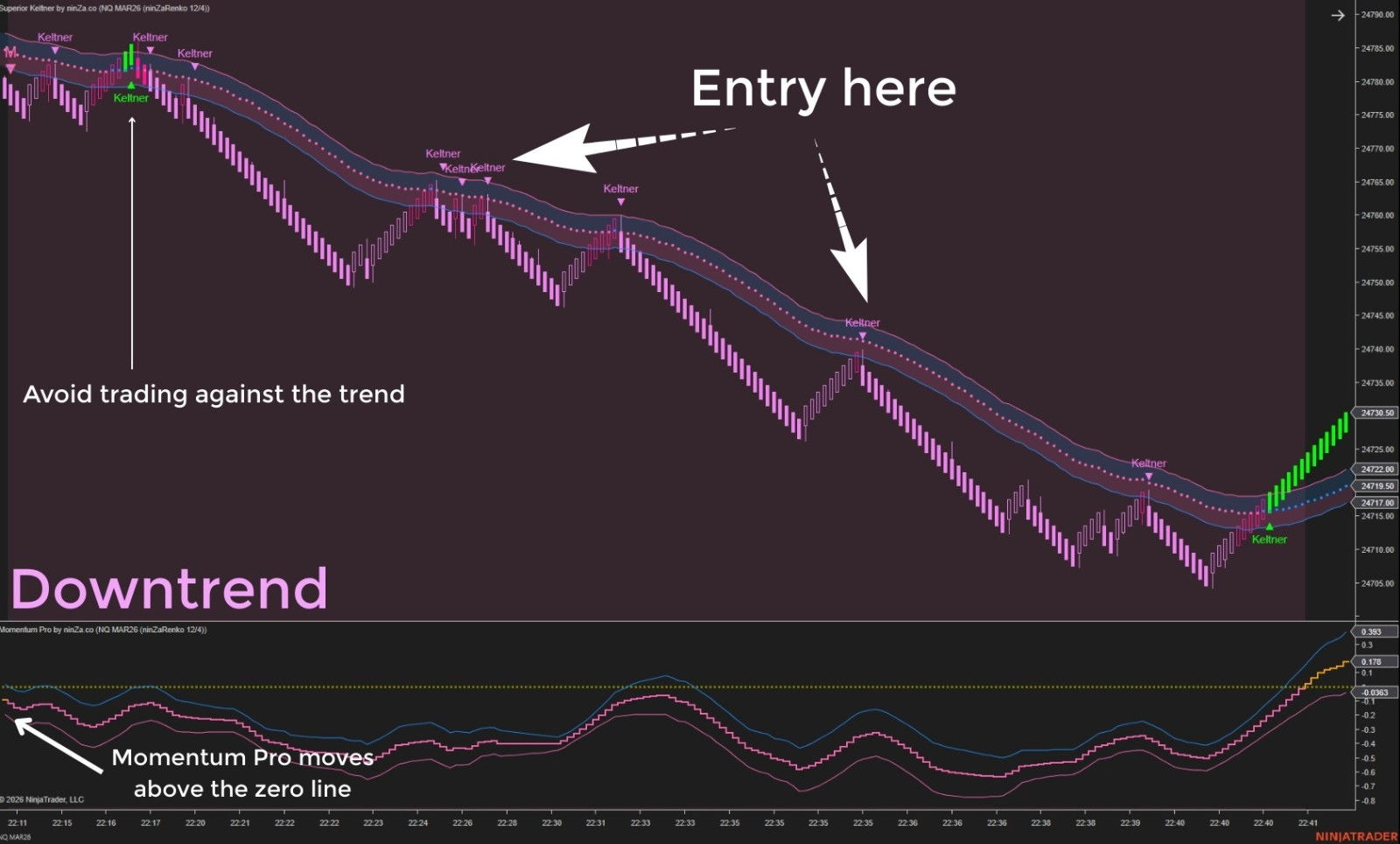
Required conditions:
Momentum Pro crosses below the zero level, confirming the start of a bearish momentum phase.
Superior Keltner generates a sell signal within the declining market structure.
A short position is executed when both conditions occur in alignment.
Any buy signal generated by Superior Keltner while Momentum Pro remains below zero is disregarded, as it represents a counter-trend signal.
Stop loss is placed above the most recent swing high or above the upper Keltner channel boundary.
Profit targets can be defined at the next support level or using a minimum Risk–Reward ratio of 1:2.
Operational Guidelines
Do not trade when Momentum Pro fluctuates around the zero level without a clear directional move.
Avoid taking signals that oppose the prevailing momentum direction.
Superior Keltner signals should only be used as confirmation within the established momentum phase.
Maintain consistent risk management for each trade.
This approach focuses on entering trades only after directional momentum is established, rather than attempting to predict reversals.
Strategy Assessment
Strengths:
Clear separation between momentum identification and trade execution.
Systematic filtering of counter-trend signals.
Structured entry points using volatility channels.
Applicable across multiple timeframes.
Limitations:
Momentum shifts may occur slightly after the initial move has begun.
Performance can be reduced in low-volatility or sideways market conditions.
Requires consistent adherence to the directional filter.
Conclusion
The combination of Momentum Pro and Superior Keltner forms a structured trend-following strategy. Momentum Pro determines when a directional phase begins, while Superior Keltner identifies trade opportunities within that phase.
By executing only the signals that align with confirmed momentum, the strategy reduces counter-trend exposure and focuses on participating in established directional movement.