Flex TPO is not designed for a fixed trading style.
Its real strength lies in the flexibility of Mode 1 (Continuous) – especially in how you configure the Period.
By simply adjusting the Period appropriately, you directly change:
- Signal frequency
- Holding time
- Expected profit range
- The trading rhythm that fits you best
In other words, Flex TPO does not force you into a specific approach – you adapt it to match your style.
You can purchase Flex TPO individually (~60% OFF) or combine it with other indicators to enhance your trading performance while enjoying greater cost efficiency:

Here are some combo options with Flex TPO at very affordable prices for you to consider:
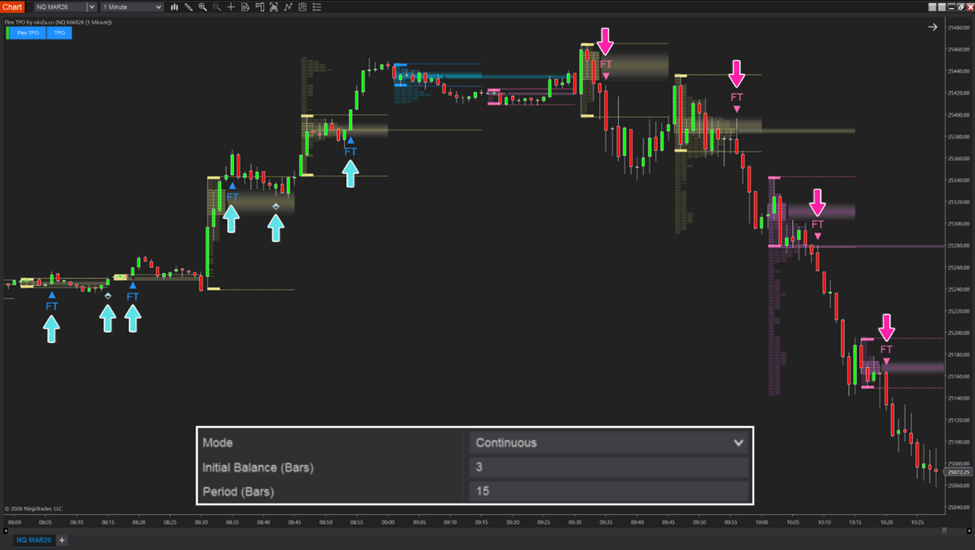
1️⃣ Scalping – Smaller period, more signals
When you set a smaller Period, the Initial Balance forms more frequently.
This leads to:
- More Break signals
- More Retest opportunities
- Shorter structural cycles
- Faster trading pace
This configuration is ideal for:
- Traders who want multiple setups within a single session
- Those focused on short expansion moves
- Scalpers trading during high-volatility conditions
On NQ, this approach works best during the US market open.
However, higher frequency requires strong discipline and tight risk management.
Suggested settings:
- Initial Balance (Bars) = 2 → Period (Bars) = 10
- Initial Balance (Bars) = 3 → Period (Bars) = 15
- Initial Balance (Bars) = 5 → Period (Bars) = 30
2️⃣ Intraday – Larger period, fewer signals but wider ranges
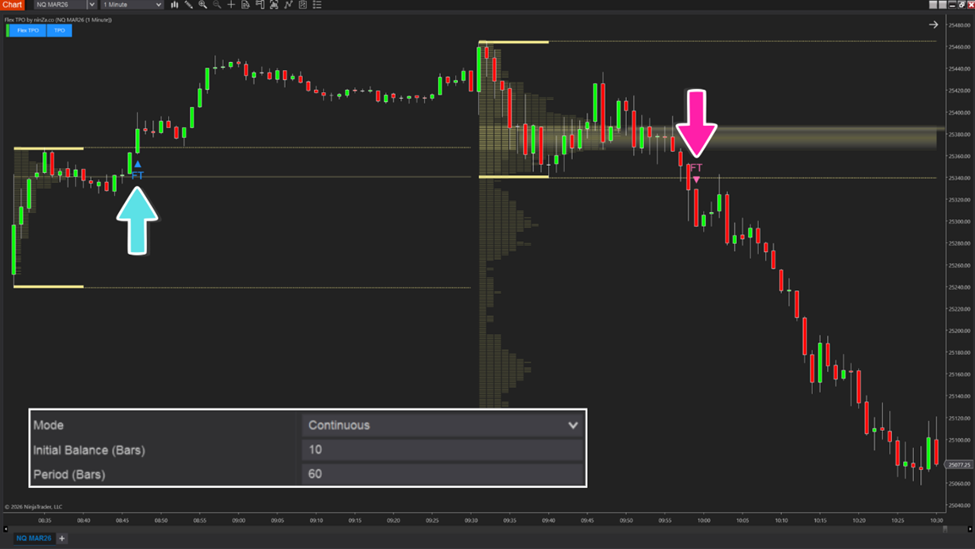
When you increase the Period, the Initial Balance forms less frequently.
As a result:
- Fewer signals
- Broader structure
- Larger expansion ranges
- More selective, higher-quality setups
This configuration suits traders who:
- Do not want to overtrade
- Focus on capturing the primary move of the day
- Prioritize quality over quantity
When price breaks out of a larger Initial Balance, the move is typically stronger and more decisive.
Suggested settings:
- Initial Balance (Bars) = 10 → Period (Bars) = 60
- Initial Balance (Bars) = 20 → Period (Bars) = 120
- Initial Balance (Bars) = 40 → Period (Bars) = 240
3️⃣ Trading NQ – Optimal session
For NQ, liquidity and volatility are key.
Most effective trading hours:
09:30 – 16:00 (UTC -5)
During this window:
- Highest volume
- Cleaner Breaks
- More precise retest reactions
4️⃣ Trading GC – 3 major sessions
GC is heavily influenced by global capital flows. As a result, liquidity remains strong throughout the trading day. However, it is best to focus on the 3 primary sessions:
- Asia session: 19:00 – 04:00
- London session: 03:00 – 12:00
- New York session: 08:00 – 17:00
- The London – New York overlap (08:00 – 12:00) typically produces the strongest volatility.
Flex TPO is built for traders who prioritize structure over prediction.
Whether you are a scalper or an intraday trader, the foundation remains the same:
- Identify balance
- Wait for the Break
- Observe the Retest
You can purchase Flex TPO individually (~60% OFF) or combine it with other indicators to enhance your trading performance while enjoying greater cost efficiency:
Here are some combo options with Flex TPO at very affordable prices for you to consider:
Victor Dan / Trader at ninZa.co