ApexFlow Zignal is built as a decoder of order-flow behavior, not just a tool that spits out raw volume or delta.
Instead of showing isolated numbers, the indicator classifies the market candle by candle into different signal mechanisms – each one representing a distinct state of buying or selling pressure:
- Absorption: One side puts in a lot of effort, but price fails to move accordingly – this usually suggests strong opposing interest absorbing that pressure. Commonly seen near short-term highs or lows, or around key resistance and support zones.
- Exhaustion: The trend is still technically intact, but momentum starts to fade (smaller bodies, shrinking range, weaker volume) – often signaling the late stage of a move or an upcoming transition in market state.
- Push (initiative drive): One side clearly dominates participation, and the result shows up immediately on price (decisive candle, strong close, small wicks, expanded body and range) – this represents initiative order flow with solid continuation potential.
Among these signal groups, Push is often the most practical and reliable choice when your goal is to trade with the trend.
The reason is simple: a Push does not just show effort (volume, delta, participation skewed heavily to one side), it also requires a clear result (price actually moves and closes with conviction).
That combination helps filter out noise and makes Push well suited as an entry trigger – especially when paired with a minimal trend filter like EMA.
EMA defines directional bias. Push helps identify the moment the market begins to accelerate in that direction.
You can purchase ApexFlow Zignal individually, or bundle it with other products to enjoy significantly better pricing:
1. What makes a Push a Push?
A Push forms only when 2 major components align at the same time: Participation/ Effort, and Result / Outcome.
a. Participation and Effort
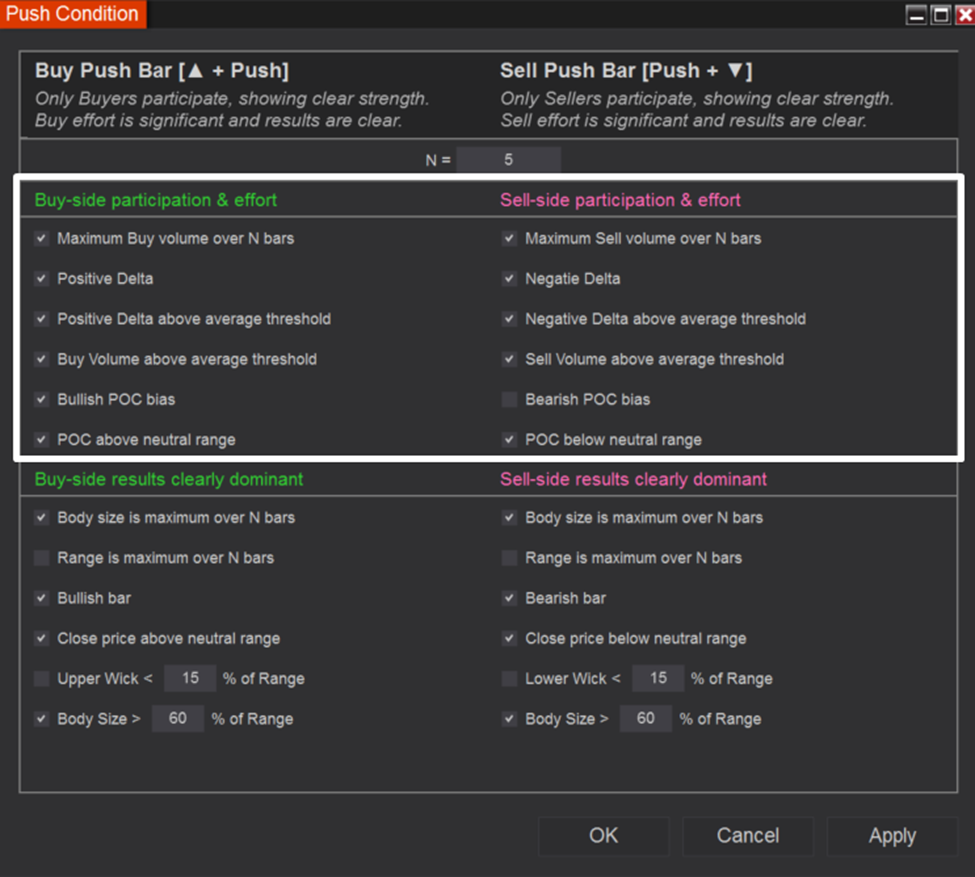
This answers one key question:
“Which side is actually in control?”
Standout buy or sell volume (Typically above average and or the highest within N bars)
Clear delta imbalance
o Buy Push: strong positive delta
o Sell Push: strong negative delta
POC bias aligned with the winning side: The Point of Control reflects where execution concentrates, and in a Push it usually sits on the correct side of the neutral range.
b. Result and Outcome
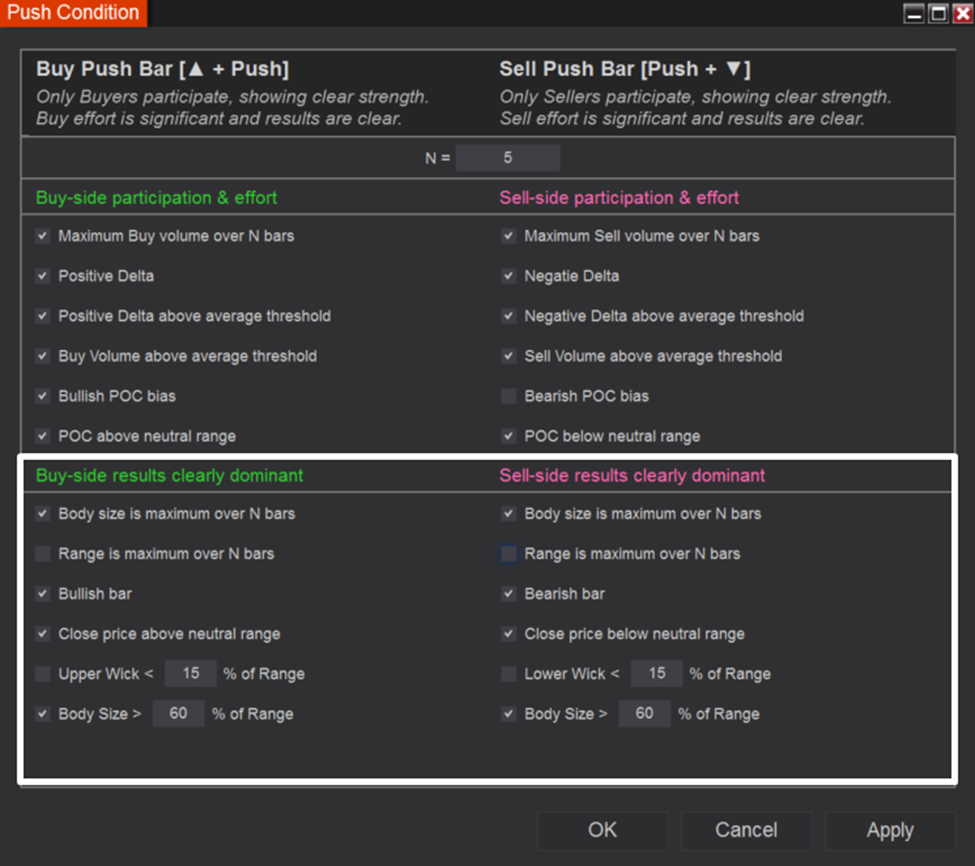
This answers the second question:
“Did that effort actually move price in a meaningful way?”
Large, decisive candle body (often the largest within N bars or among the top group)
Expanded range (Shows real price displacement)
High-quality close
o Buy Push: close near the high or above the neutral zone
o Sell Push: close near the low or below the neutral zone
Small wicks (Little rejection, weak opposing response)
High body-to-range ratio (Price moves cleanly forward instead of chopping back and forth)
2. Why Push matters
Push is one of the cleanest trend-following signals because it confirms both sides of the equation:
there is real pressure, and price actually goes somewhere.
Unlike:
- High volume or delta with no progress (usually absorption)
- Weakening momentum late in a move (exhaustion)
A Push requires visible confirmation on the chart: solid body, decisive close, small wicks, and range expansion.
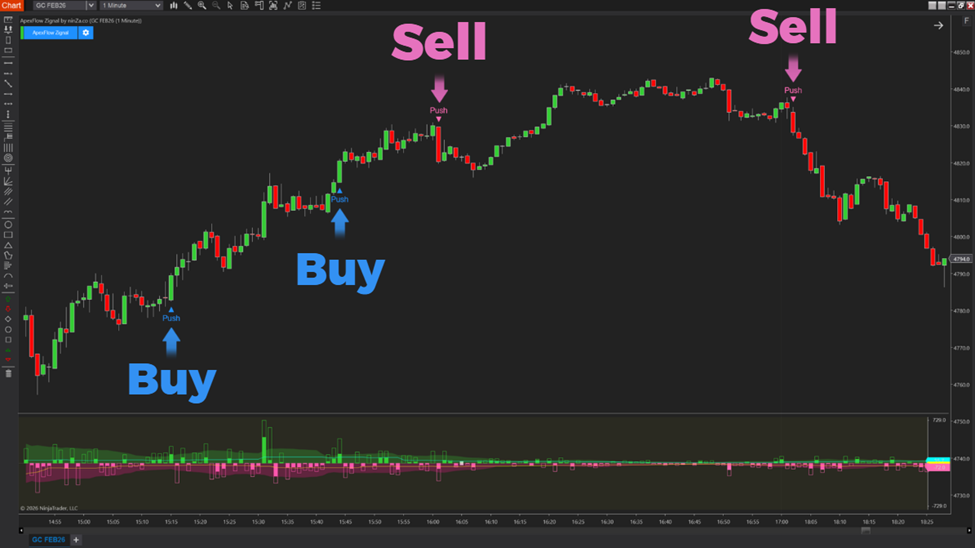
In live trading, Push often appears when the market is ready to continue and pick up speed in the dominant direction.
That makes it a practical entry trigger, rather than a guess at tops or bottoms.
Another key advantage is that Push is built on semi-quantifiable rules – volume, delta, POC bias, candle structure – making it easier to define, backtest, and execute with discipline.
3. Push + EMA strategy: a minimal trend - following framework
The idea is intentionally simple:
- EMA’s only role is to define trend direction.
- Push is the timing trigger used to enter when momentum starts to build.
Buy setup checklist
Step 1: Price is trading above the EMA – uptrend confirmed – only look for buy setups.
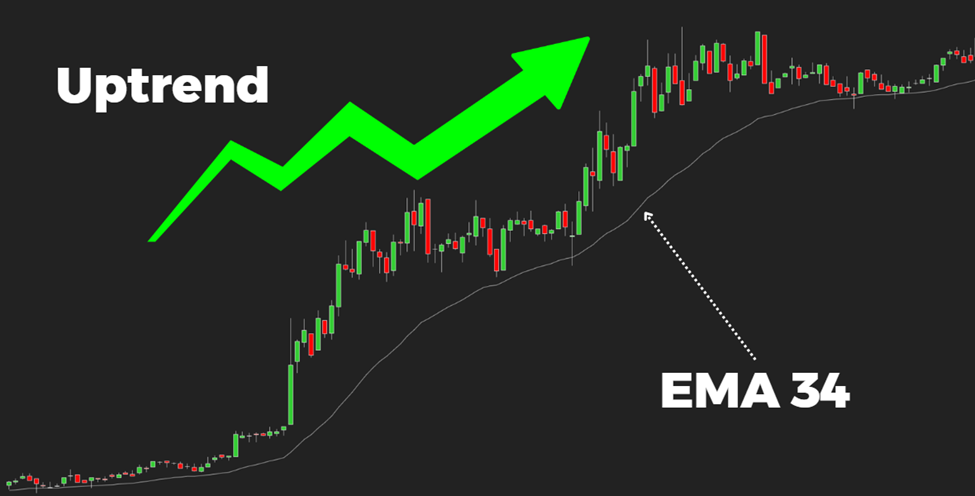
Step 2: Enter when ApexFlow Zignal prints a bullish Push aligned with the trend.
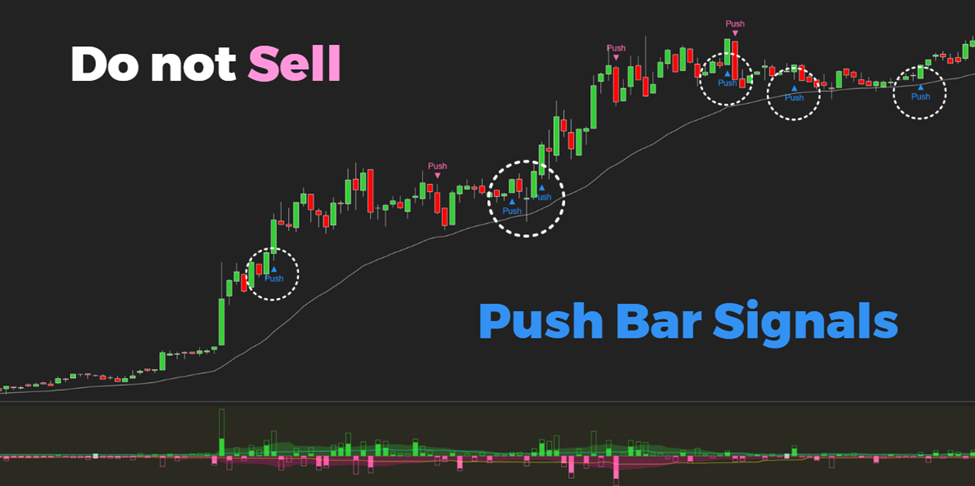
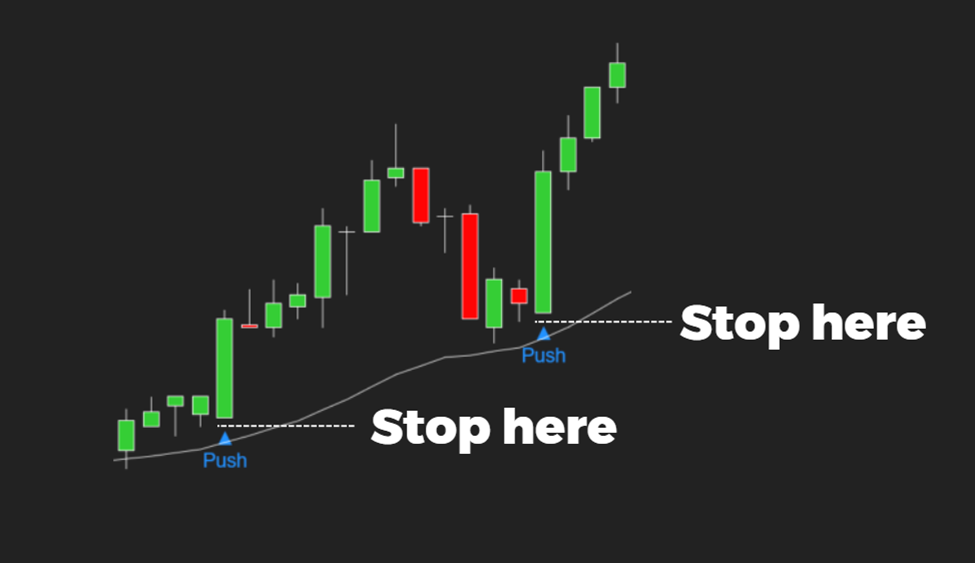
Step 3: Place stop loss just below the Push signal candle, or exit if price closes back below the EMA.
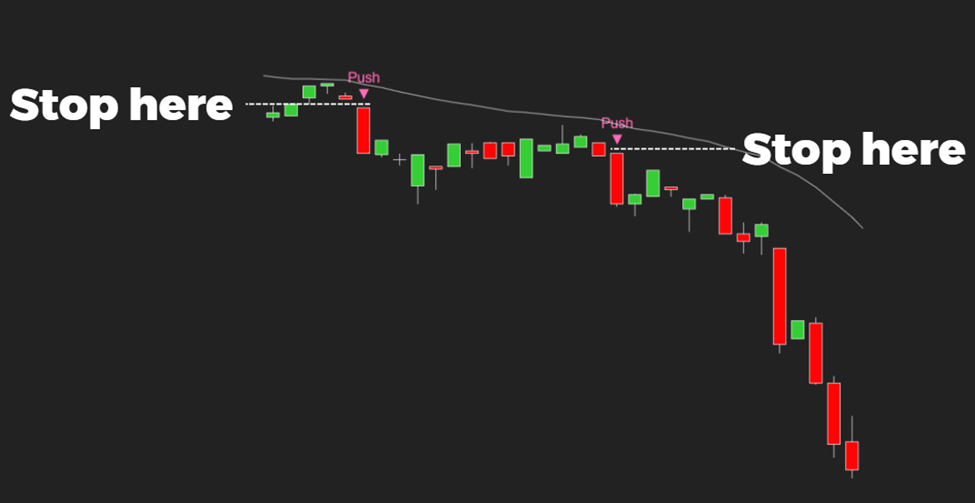
Sell setup checklist
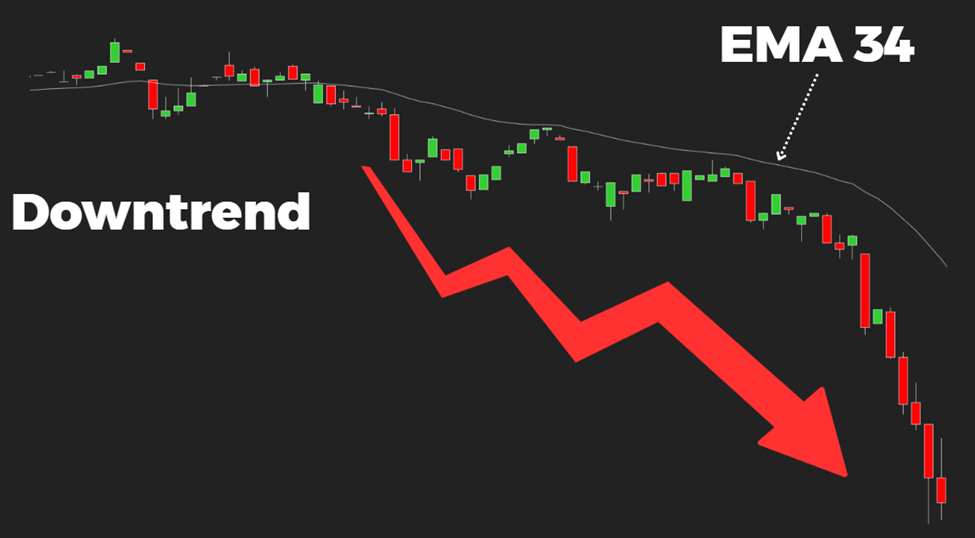
Step 1: Price is trading below the EMA → downtrend confirmed → only look for Sell setups.
Step 2: Enter when ApexFlow Zignal prints a bearish Push aligned with the trend.
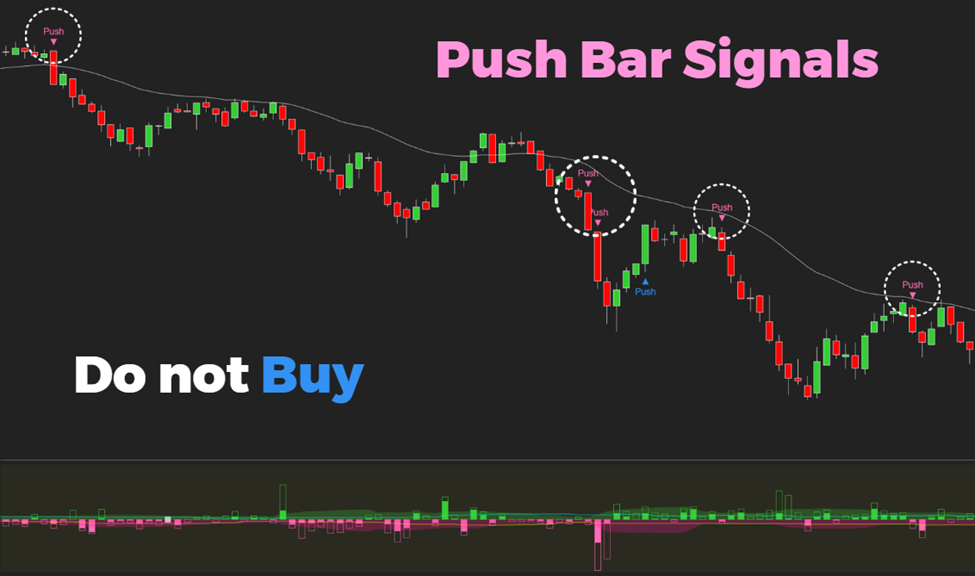
Step 3: Place stop loss just above the Push signal candle, or exit if price closes back above the EMA.
You can purchase ApexFlow Zignal individually, or bundle it with other products to enjoy significantly better pricing:
Victor Dan / Trader at ninZa.co