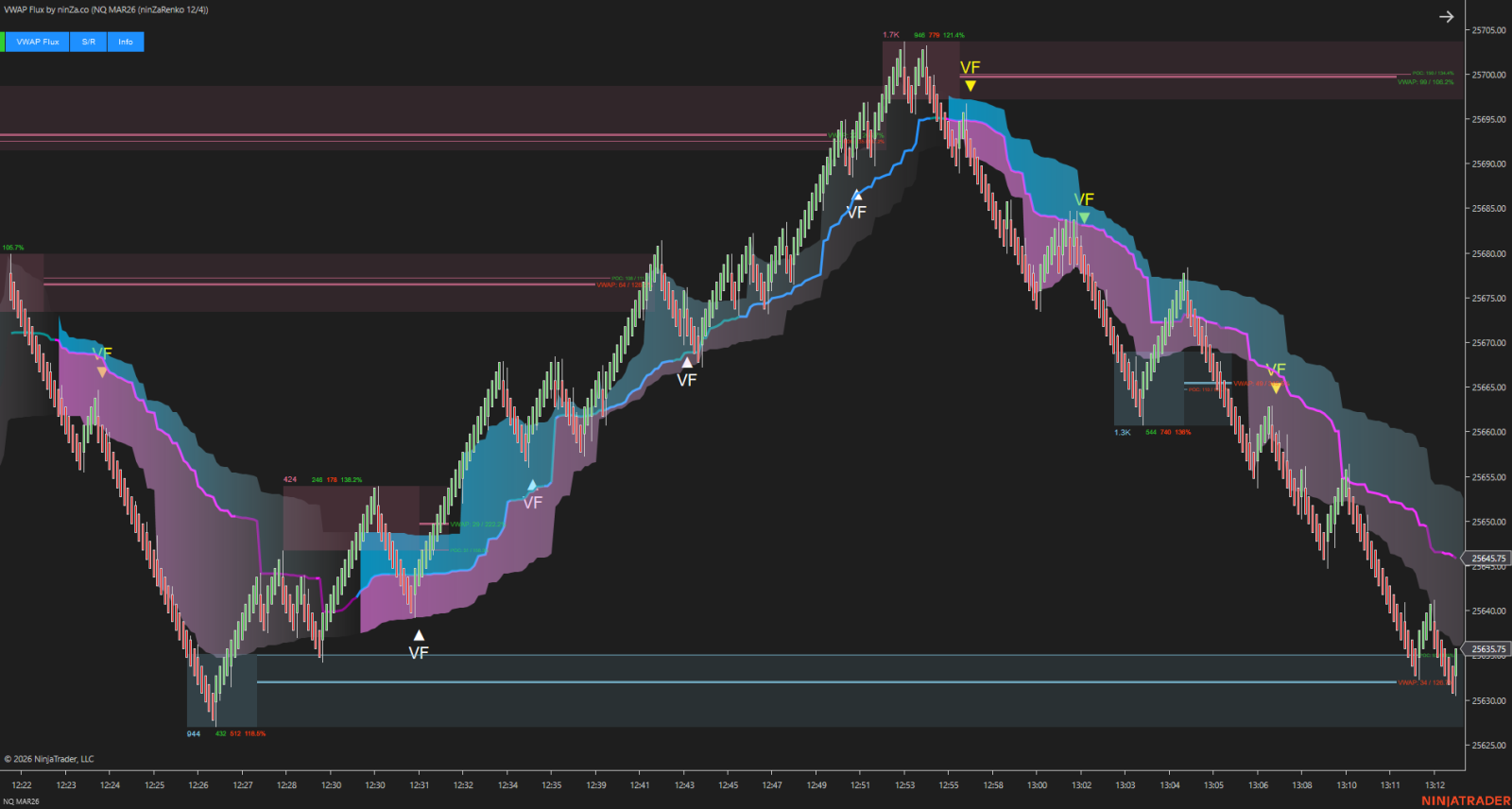
One of the biggest advantages of VWAP Flux is its adaptability.
VWAP Flux uses a linear-based methodology to address the structural weaknesses found in traditional VWAP.
Instead of relying on a single, session-wide calculation, VWAP Flux divides the market into smaller time segments – 10 minutes, 30 minutes, 1 hour, and more – and recalculates VWAP for each segment in real-time.
Traditional VWAP bands depend on fixed multipliers. As volatility increases, these multipliers expand dramatically, creating wide zones that lose their practical relevance.
VWAP Flux, on the other hand, forms dynamic bands based on two key parameters:
AnchorPeriodMinutes: The time span for each VWAP layer.
Example: AnchorPeriodMinutes = 30 → each layer reflects the most recent 30 minutes of traded value.
Amount: The number of recent VWAP layers included in the trading cloud.
Example: Amount = 3 → the indicator selects the 3 most recent VWAP layers to form the band.
These controls allow you to adjust how responsive or stable your value zones are, something traditional VWAP can’t offer:
Smaller Amount values → More responsive bands, ideal for fast-moving markets.
Larger Amount values → Steadier bands that reveal broader swings and market rhythm.
This approach aligns with the methods widely discussed by Brian Shannon, author of Technical Analysis Using Multiple Timeframes.
In this video, James Buchman explains why VWAP Flux is essential for VWAP traders, highlighting how it identifies clear support and resistance zones, making trade opportunities easier to spot: