VWAP stands for Volume Weighted Average Price. It is a line on the price chart that measures the price level at which the market has traded with the most volume during the session. Simply put, VWAP not only looks at the price but also how many shares or lots were exchanged at each price level to calculate the average.
In the UTS study, it is precisely defined as: VWAP = the total value of all trades (price × volume) divided by the total volume for the session. In other words, it is the volume-weighted average of all the trades that have occurred from market open to the present time.
How VWAP Differs from MA (Moving Average)?
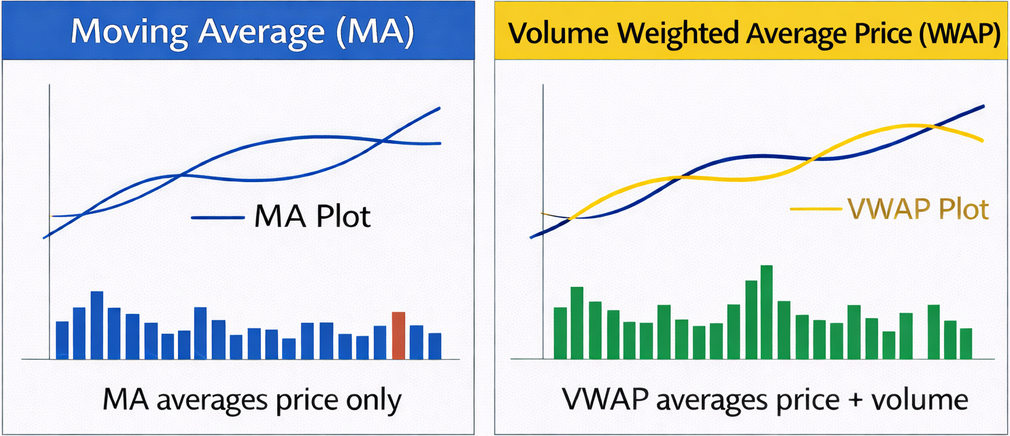
At first glance, VWAP appears to be similar to a moving average (MA). However, the key differences lie in the calculation method and the purpose in trading:
1. MA is price-based, VWAP is price-based with volume.
MA (Simple or Exponential) only calculates the average price over a fixed time period, for example, 10 days or 50 periods, ignoring the trading volume. This can sometimes cause distortions, like when prices rise but the volume is low or when prices fall with a high volume.
In contrast, VWAP incorporates volume into the equation: if the price is high but volume is low, the VWAP line may be lower than the current price, and vice versa. This is the most important difference.
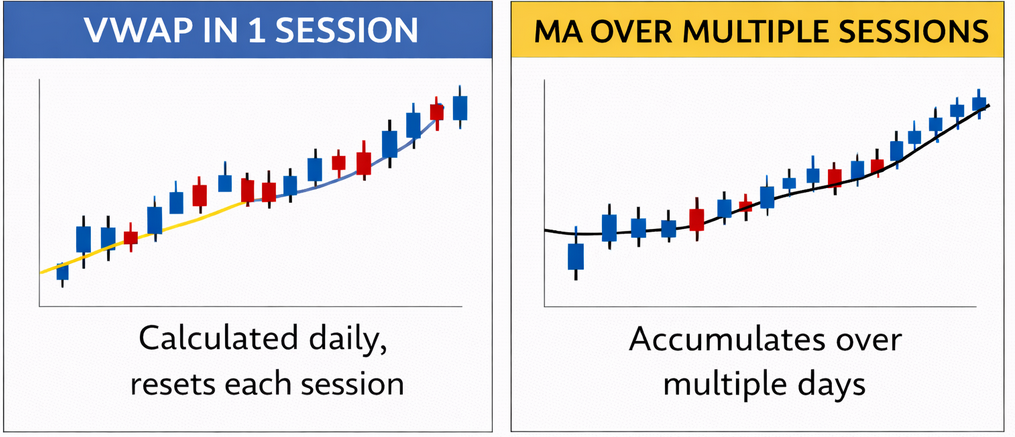
2. VWAP is session-based, MA is period-based.
VWAP is calculated from the market open to close during a single session and resets every day. Therefore, it is especially useful in short-term and intraday trading.
On the other hand, MA is a cumulative line that spans multiple sessions without resetting, making it better suited for "trend confirmation" rather than for benchmarking the price for the day.
Why is VWAP Important?
VWAP is important because it answers a very practical question in trading: At which price level did the market really trade the most in terms of volume during the session?
1. VWAP as a benchmark for the day's price
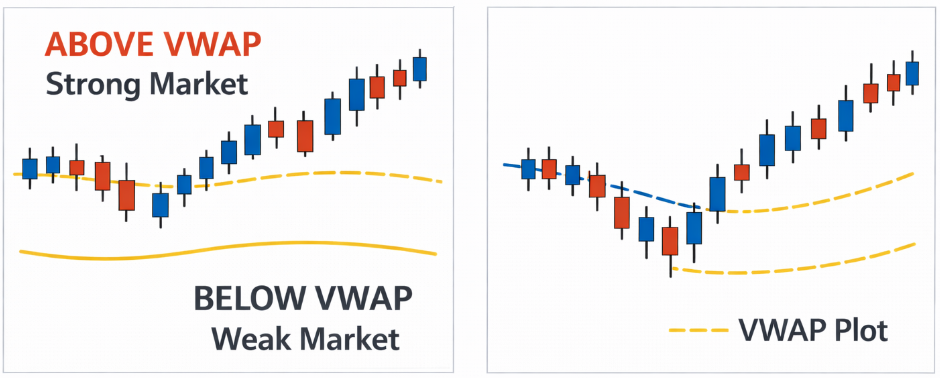
When you look at the chart, the VWAP line tells you "the average price at which the market has actually traded." If the current price is above VWAP, the market is maintaining a positive supply-demand balance; if it's below VWAP, the market could be weaker on the buying side. This data point is crucial for intraday trading.
2. VWAP helps assess the quality of execution
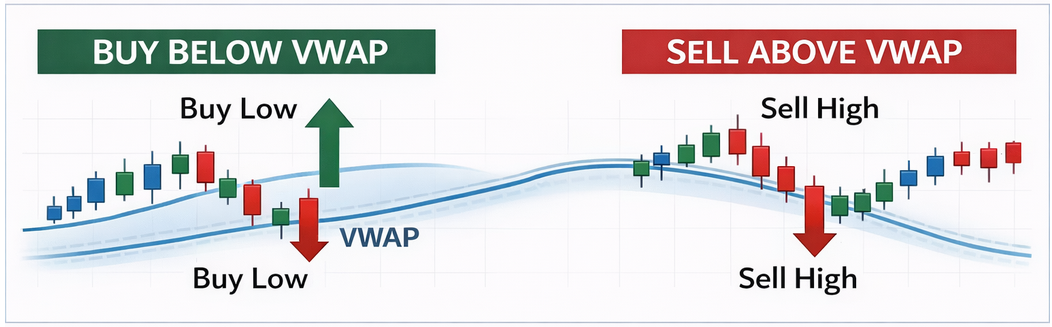
If you're a trader or a large fund, the goal is to buy below VWAP or sell above VWAP – meaning you get a better price than what the market has actually traded at. This is the benchmark that institutions use to evaluate order strategies.
3. VWAP provides entry/exit signals based on “real market data”
In intraday strategies:
Buy signal: Price rises and stays above VWAP → indicates that buying pressure is outweighing the total volume for the session.
Sell signal: Price drops below VWAP → indicates a weak market, possibly a distribution zone.
Since VWAP considers volume, it is less affected by small price candles with low liquidity compared to MA lines, which are based solely on price.
Conclusion
VWAP is not just another MA. It is a central benchmark for intraday trading, reflecting the true value traded based on volume, not just a plain average price line.
While it does not replace MA in all strategies, for intraday traders and execution traders, VWAP is the guiding star for evaluating price value and execution quality during the trading session.