This strategy is based on the principle of identifying the trend on a higher timeframe and executing entries on a lower timeframe, without being fixed to specific timeframes. Traders only need one higher timeframe (HTF) and one lower timeframe (LTF).
1. Core Principles
Trade in the direction of the higher-timeframe (HTF) trend
Use a lower timeframe (LTF) to optimize entries and tighten stop losses
Only trade pullbacks on the LTF that align with the HTF trend
Stay out of the market when:
Applicable to all Forex currency pairs
Objective: consistent and stable trading
2. Flexible Timeframe Selection
Guidelines:
- The HTF should be at least 3–5 times higher than the LTF
Examples:
D1 / H1
H4 / M15
H1 / M5
M30 / M5
3. Trend Structure Used
The strategy uses EMA Colorized 4U to define trend and pullbacks:
HTF: EMA 8, EMA 21 (EMA Colorized 4U)
LTF: EMA 8, EMA 13, EMA 21 (EMA Colorized 4U)
Valid trend conditions:
EMAs are properly aligned
EMAs are clearly separated and pointing in the same direction
Price remains above the EMAs in an uptrend or below the EMAs in a downtrend
4. Entry Rules
BUY Setup
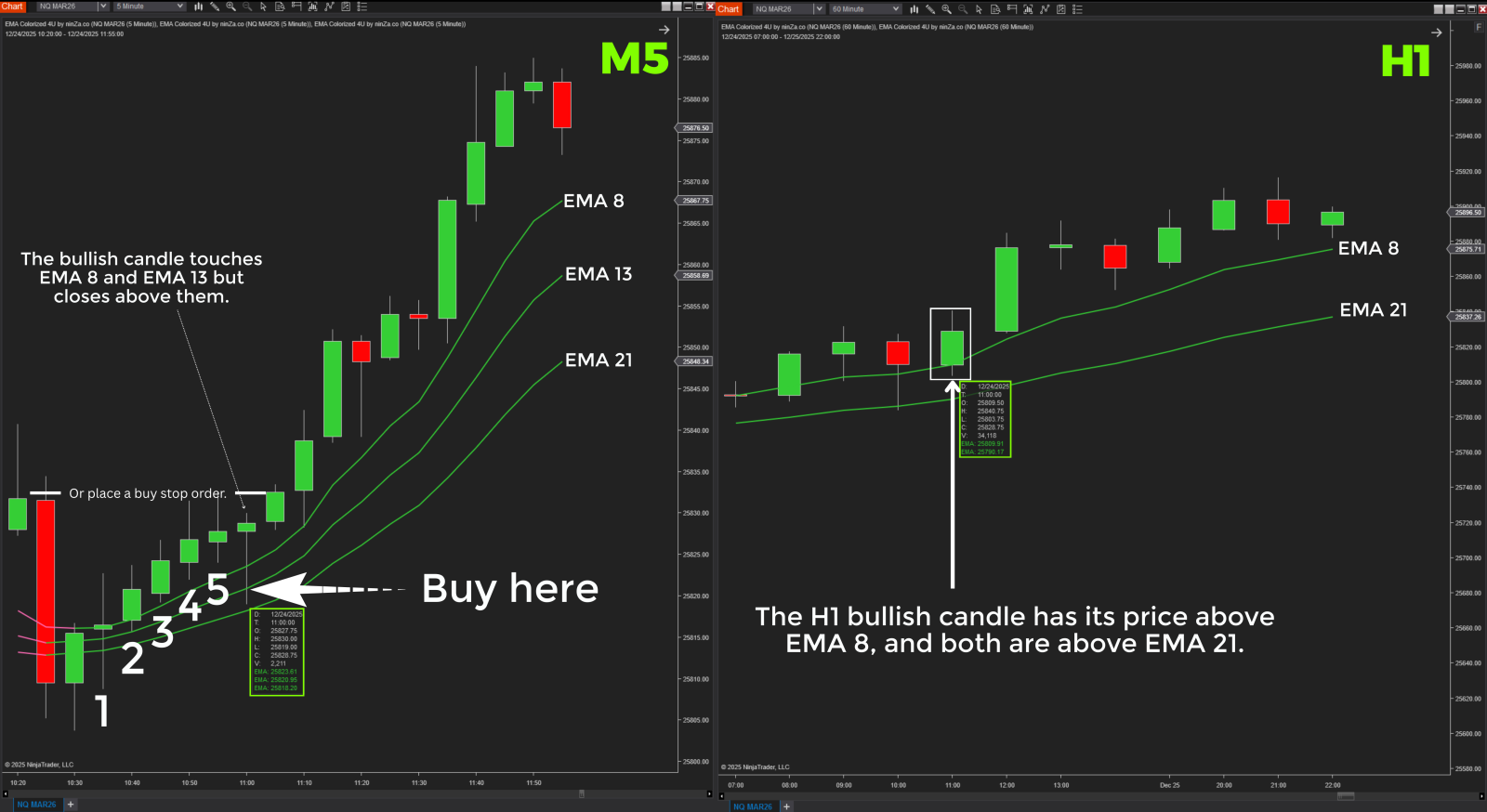
Trend conditions (HTF):
Conditions on the LTF:
Signal candle:
Entry methods (choose one):
Buy at Market immediately after the signal candle closes
Buy Stop placed above the highest high of the last N candles
Stop Loss: below the low of the signal candle (with a timeframe-appropriate buffer)
SELL Setup
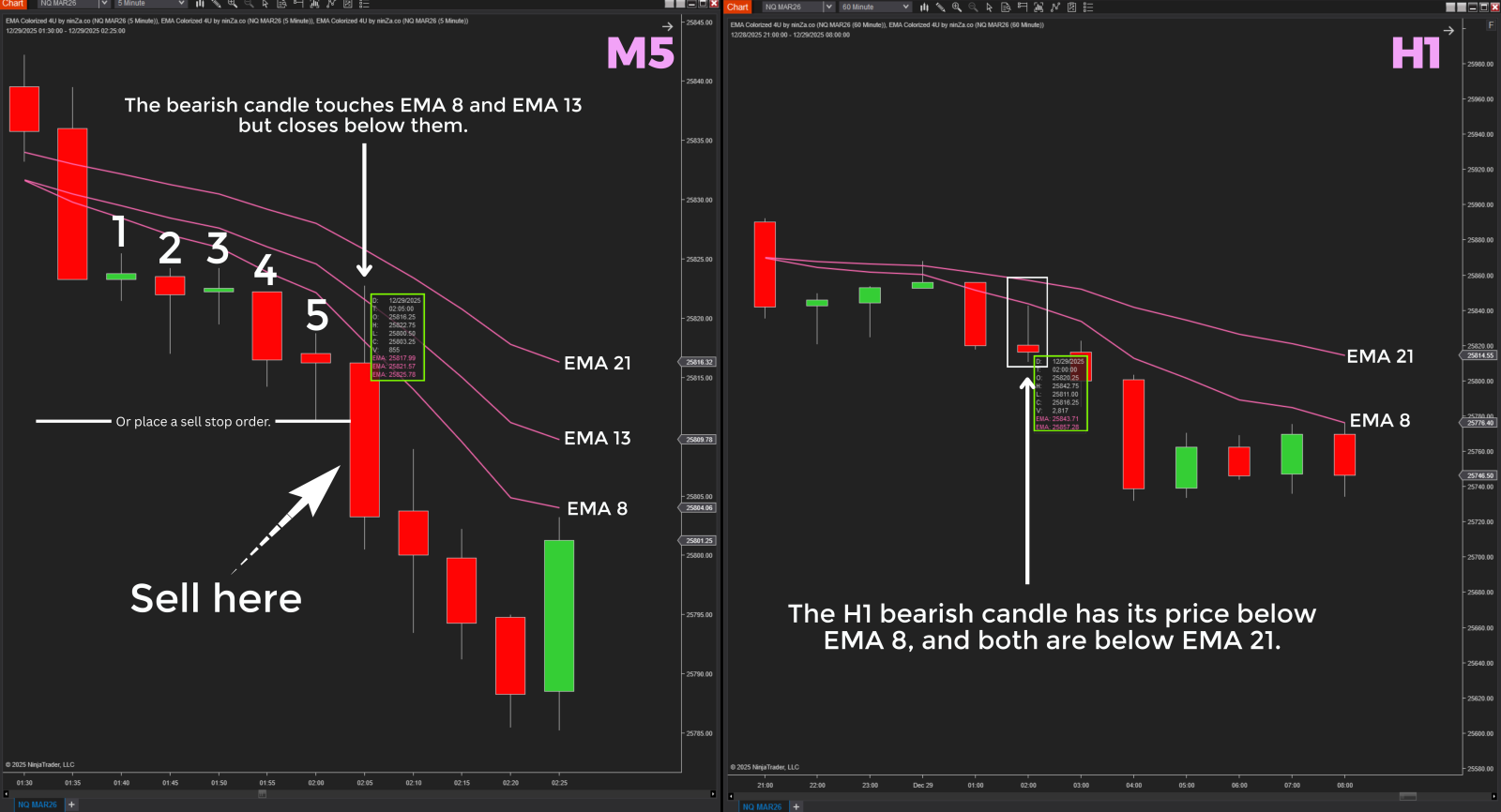
Trend conditions (HTF):
Conditions on the LTF:
Signal candle:
Entry methods (choose one):
Sell at Market immediately after the signal candle closes
Sell Stop placed below the lowest low of the last N candles
Stop Loss: above the high of the signal candle (with a timeframe-appropriate buffer)
5. Trade Management and Exit Rules
Then choose one:
6. Summary
This version of the strategy:
Is not restricted to fixed timeframes
Allows flexible entry methods (Market or Stop orders)
Maintains a pure trend-following approach
Is suitable for different trading styles