1. Challenges traders face at “key price levels”
Many traders can easily identify:
The real challenge is not seeing these areas, but knowing:
Many losing trades happen when we enter just because the price hits a certain boundary, trade without checking order flow, or can’t tell the difference between failed effort and accepted effort. This Delta Flip at Donchian strategy is built to help avoid those common pitfalls.
2. Superior Donchian - a dynamic price structure
The Superior Donchian consists of:
Upper Band: the highest price over N periods
Lower Band: the lowest price over N periods
Middle Band: the midpoint between upper and lower
The Superior Donchian is not just a technical indicator. It represents a dynamic price structure where the market often:
The Donchian boundary is where order flow must confirm direction.
3. Understanding Delta Flip: What it really shows
A Delta Flip is not simply delta changing sign. It represents a transfer of control in order flow at a key price area.
Typical Delta Flip scenario at Donchian boundaries (Upper & Lower)
Price approaches or reaches a Donchian boundary (Upper or Lower). This is where the market often tests liquidity.
A strong candle appears against the initial expectation, with large delta
At the Upper Donchian: a strong bearish candle with large negative delta
At the Lower Donchian: a strong bullish candle with large positive delta
This indicates:
The initial effort is not accepted
A false breakout or liquidity sweep is occurring
Immediately after, price reverses strongly with large delta in the opposite direction
This confirms:
Prior orders have been absorbed
The opposite side has regained control
Real participation has entered the market
In this context, the Delta Flip confirms that the market has chosen a side, not a random or noisy reaction.
4. Strategy logic
This Delta Flip at Donchian strategy focuses on decision points where the market must commit. A valid setup requires:
Price approaching a Donchian boundary
A break or sweep to attract liquidity
Evidence of an initial failed effort (false break or rejection)
A Delta Flip confirming a shift in control
This is not a strategy for picking tops or bottoms, guessing reversals, or waiting for a new trend to form.
It trades real order flow behavior:
5. Delta Flip Breakouts: Entry & Exit Rules
5.1. Steps for a Buy setup
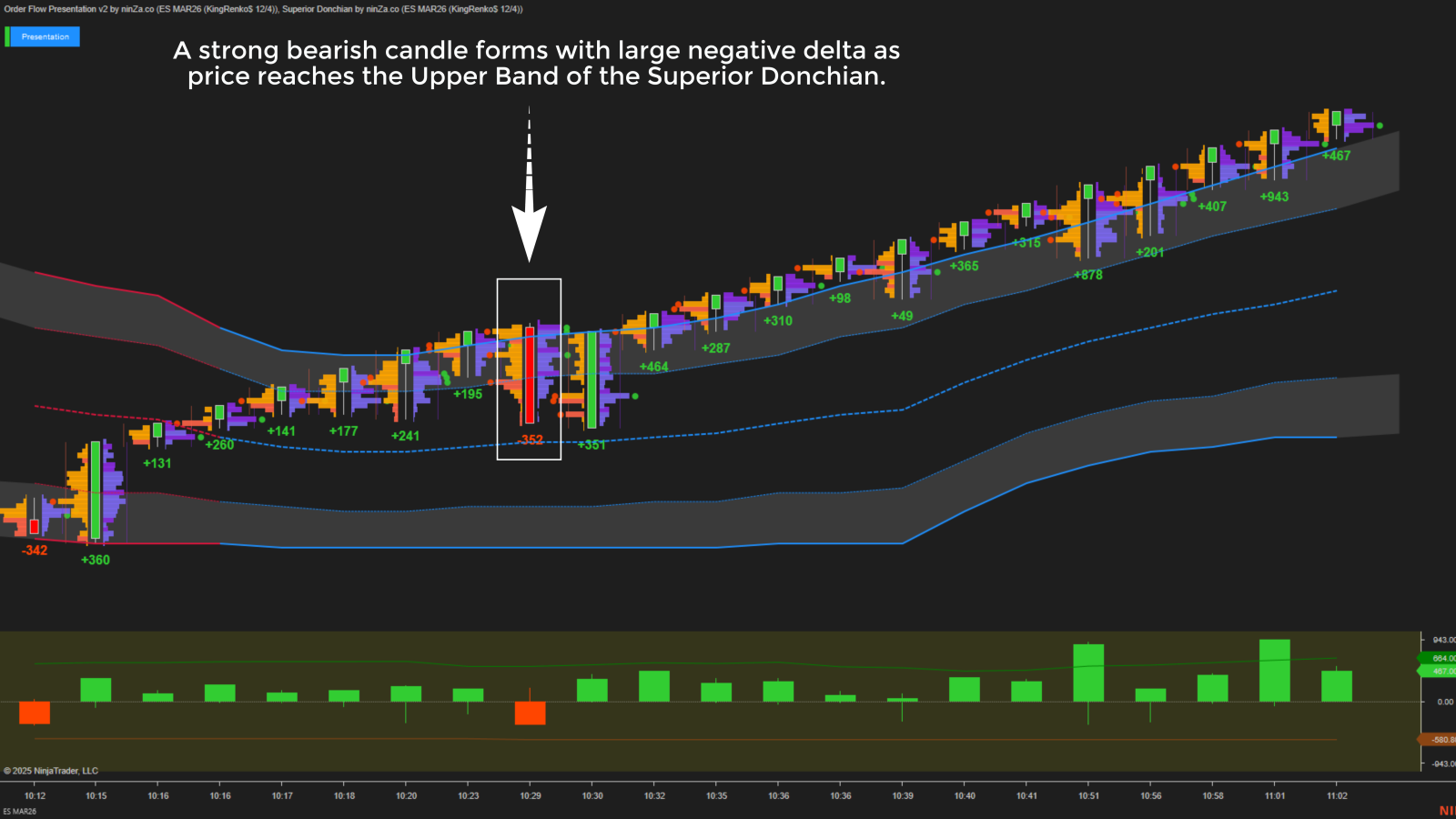
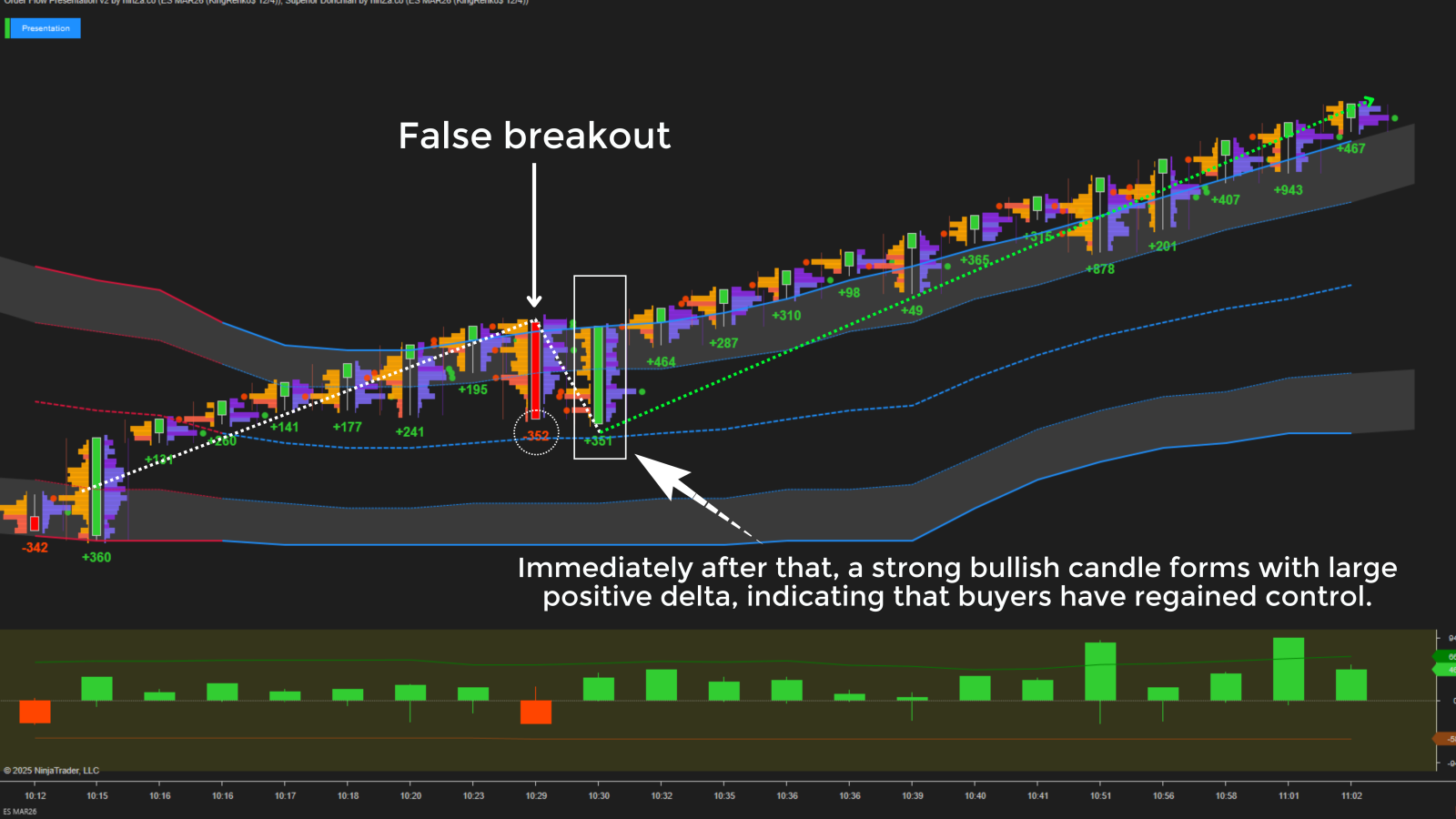
Required conditions
Price approaches or reaches the Upper Donchian
A break or sweep above the Upper Donchian occurs to attract liquidity
Immediately after, a strong bearish candle appears with large negative delta→ indicates a failed breakout attempt / buyers are absorbed
This is followed by a strong bullish candle with large positive delta
Delta flips from negative to positive, confirming buyers have regained control
Price holds above the Upper Donchian and does not fall back inside the channel
Trade management
Stop Loss:
- Below the sweep / failed breakout low
- Or below the Upper Donchian (risk-dependent)
Take Profit:
Early exit rule
Exit immediately if:
A strong bearish candle with large negative delta appears
Price closes back inside the Donchian Channel
Delta flips back from positive to negative, indicating buyer failure
5.2. Steps for a Sell setup
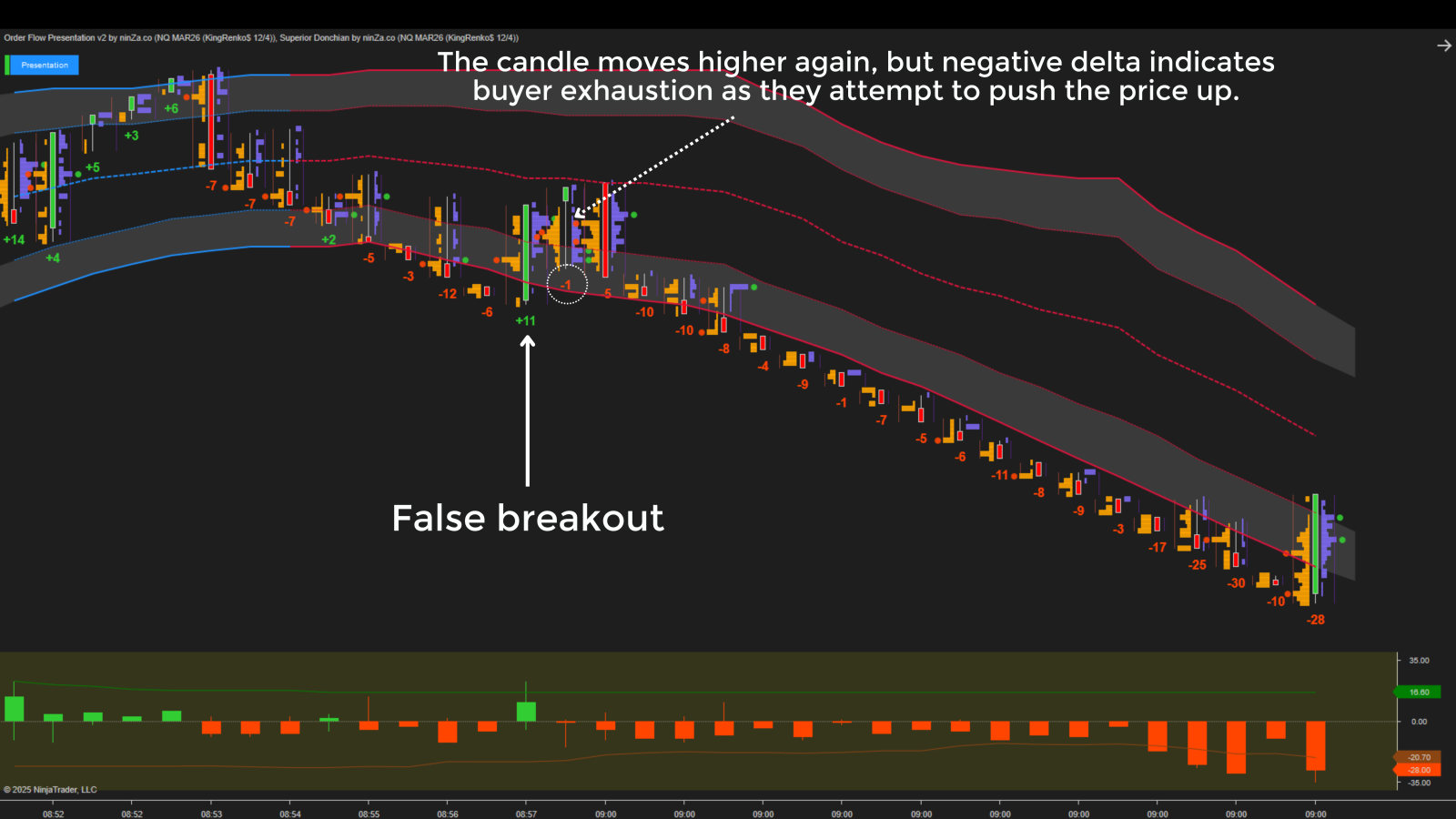
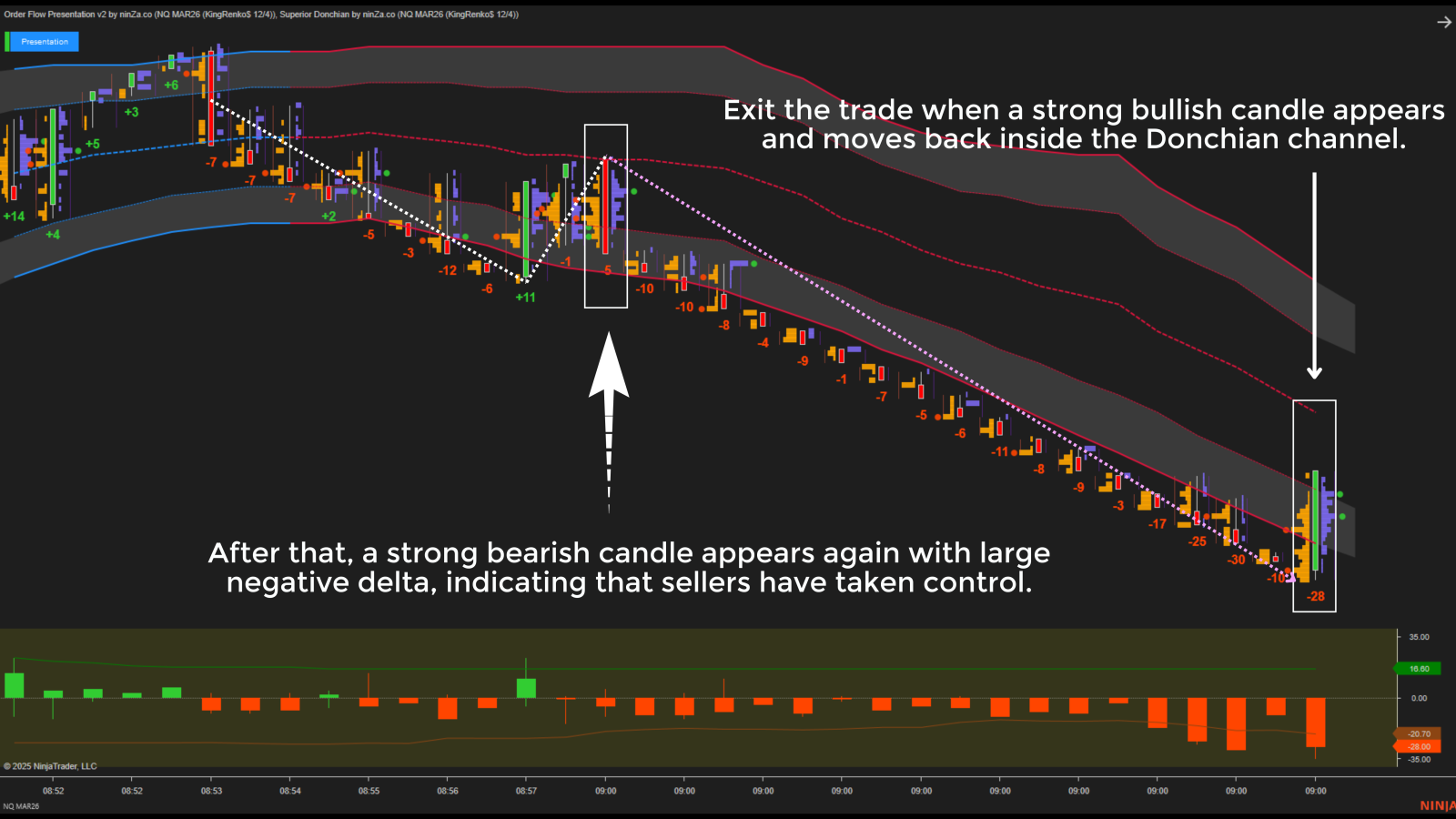
Required conditions
Price approaches or reaches the Lower Donchian
A break or sweep below the Lower Donchian occurs to attract liquidity
Immediately after, a strong bullish candle appears with large positive delta→ indicates a failed breakdown attempt / sellers are absorbed
This is followed by a strong bearish candle with large negative delta
Delta flips from positive to negative, confirming sellers have regained control
Price holds below the Lower Donchian and does not reclaim the channel
Trade management
Stop Loss:
- Above the sweep / failed breakdown high
- Or above the Lower Donchian (risk-dependent)
Take Profit:
Early exit rule
Exit immediately if:
A strong bullish candle with large positive delta appears
Price closes back inside the Donchian Channel
Delta flips back from negative to positive, indicating seller failure
Core principle
Do not trade breakouts based on price alone
Do not enter without a failed attempt + Delta Flip
Delta Flip must be confirmed by clear price reaction, not just a delta sign change
The market must remove one side first, then clearly show which side has taken control.
6. When you shouldn’t use this strategy
Do NOT trade when:
The market is in a tight range
Delta flips occur repeatedly and appear noisy
There is no clear sweep
Liquidity is low or major news is approaching
7. Risk and capital management
Risk per trade: 0.5% – 1% of account equity
Do not increase position size after a losing trade
Minimum reward-to-risk: 1:2, preferably 1:3
After entry:
At TP1, take 30–50% partial profit
Move stop loss to breakeven
Exit immediately if Delta flips against the position